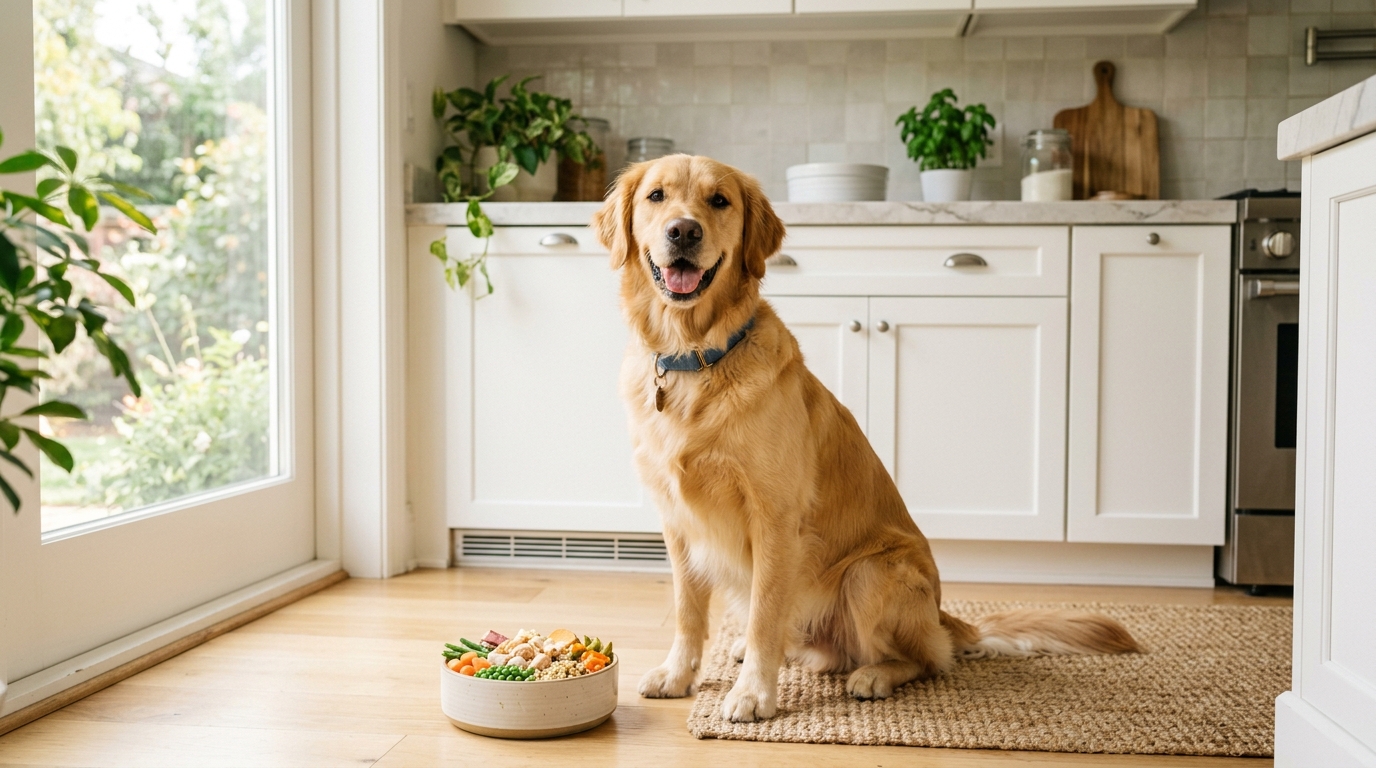
Probiotics for dogs are live beneficial bacteria given to support a balanced gut microbiome, and the clearest published benefit is faster normalisation of the gut and improved stool consistency during and after digestive upsets. They are strain-specific, they work while you give them rather than curing anything permanently, and they are best judged over two to four weeks, not two days.
Quick answer
Give a canine-specific probiotic daily with food. Published studies in dogs show probiotic supplementation is associated with accelerated normalisation of the intestinal microbiome and improved stool consistency in acute diarrhoea. Effects are strain-dependent and individual — two dogs on the same product can respond quite differently.
Most useful times to start: during and after a course of antibiotics, around diet changes, after boarding or travel stress, and for dogs with a long history of soft or inconsistent stools once a veterinarian has ruled out other causes.
Three layers of gut support in one daily dose
Pure Majesty 3B combines probiotics, prebiotics and digestive enzymes in liquid drops — formulated to support gut health, stool consistency and immune function.
On this page
- What probiotics are and what they do
- Why gut health matters beyond digestion
- What disrupts a dog’s gut
- Signs your dog’s gut may need support
- The options, compared
- A safe at-home routine
- Strains and ingredients explained
- Cost and realistic timelines
- Common mistakes owners make
- When to see the veterinarian
- FAQ
What probiotics are and what they do
A probiotic is a live micro-organism that, given in adequate amounts, confers a benefit on the host. In dogs that usually means specific strains of Lactobacillus, Bifidobacterium, Enterococcus faecium or the yeast Saccharomyces boulardii, delivered daily in a powder, chew, paste or liquid.
The proposed mechanisms are well described in the veterinary literature. Probiotic organisms compete with less desirable bacteria for space and nutrients, produce short-chain fatty acids that feed the cells lining the colon, stimulate the expression of mucins and tight junction proteins that maintain the gut barrier, and interact with the gut-associated immune tissue. Research on microencapsulated canine probiotic formulations has reported exactly this pattern — stimulation of mucin and tight junction protein expression and maintenance of epithelial permeability — alongside improved stool consistency in dogs with acute diarrhoea.
Two implications follow. First, probiotics support a system rather than treating a disease. Second, because most supplemented strains do not permanently colonise the canine gut, the support lasts as long as you keep giving them.
Why gut health matters beyond digestion
The canine gut houses an enormous bacterial population and a large share of the body’s immune tissue. When that community is disrupted — dysbiosis, in clinical terms — the consequences are rarely limited to stool quality. Studies in dogs have linked gut dysbiosis to skin conditions as well; one line of research has examined probiotics modulating gut dysbiosis in dogs with atopic dermatitis, and a randomised controlled trial has evaluated a probiotic and nutraceutical supplement in privately owned dogs with pruritic dermatitis.
This is why gut support keeps appearing in conversations about itchy skin, recurrent yeast issues, gas, and general resilience. It is not a cure-all — the evidence is much stronger for digestive outcomes than anything else — but the gut is genuinely connected to more than the stool in the garden.
What disrupts a dog’s gut
- Antibiotics. Necessary and often life-saving, but indiscriminate — they reduce beneficial populations along with the target organism, sometimes for weeks after the course ends.
- Abrupt diet changes. Switching food overnight is one of the most common causes of a few days of soft stool.
- Dietary indiscretion. Bin raiding, compost, roadkill, an entire birthday cake — the classic Monday-morning veterinary appointment.
- Stress. Boarding, travel, moving house, a new baby, fireworks. Stress-related colitis is real and common.
- Parasites. Giardia, roundworms, hookworms and whipworms all disturb the intestinal environment.
- Age. Puppies have immature gut flora and immune systems; older dogs digest and absorb less efficiently.
- Chronic disease. Inflammatory bowel disease, pancreatic insufficiency and food-responsive enteropathies all change the microbiome.
Signs your dog’s gut may need support
- Chronically soft, loose, or inconsistent stools without another explanation
- Frequent gas, gurgling, or visible abdominal discomfort after meals
- Mucus or occasional fresh blood streaking on the stool surface
- Intermittent vomiting, especially bile in the early morning
- Straining, urgency, or several small stools instead of one
- Grass eating that has become a daily habit
- Dull coat or itchy skin alongside digestive signs
- A recently finished course of antibiotics
If loose stools are the main issue, our guide to probiotics for dogs with diarrhoea covers that scenario in detail.
The options, compared
Format matters more than most owners expect, because it determines both how many live organisms survive to the gut and whether you actually manage to give the full dose every day.
| Format | Strengths | Weaknesses | Best for |
|---|---|---|---|
| Liquid drops | Precise dosing by weight; easy to hide in food or give directly; good for fussy or unwell dogs | Usually needs refrigeration after opening | Small dogs, puppies, dogs who refuse chews, multi-pet homes |
| Powder sachets or scoops | Often high organism counts; simple to mix into wet food | Can be refused on dry kibble; scoop accuracy varies | Dogs on wet or mixed feeding |
| Soft chews | Excellent compliance; no measuring | Binders and flavourings add calories; heat during manufacture can reduce viability | Dogs who treat supplements as treats |
| Capsules | Good protection of the organisms | Most dogs have to be pilled | Owners comfortable giving capsules |
| Probiotic in the food | Zero extra effort | Counts are usually low and viability at end of shelf life is questionable | Maintenance only, not active support |
| Plain yoghurt or kefir | Cheap, familiar | Human strains, low counts, lactose; not canine-specific | Not a substitute for a canine probiotic |
We cover these individually in probiotic chews vs powder, dog probiotic powders, probiotic chews and probiotic dog food.
What separates a good product from a weak one
- Named strains, not just species. “Enterococcus faecium SF68” tells you something; “probiotic blend” does not. Benefits in the literature are strain-specific.
- A guaranteed count through to the expiry date, not merely “at time of manufacture.”
- Protection of viability — microencapsulation, moisture-controlled packaging, or refrigeration.
- A prebiotic included. Inulin, FOS or MOS feed the organisms you are adding.
- Formulated for dogs, with canine-relevant strains rather than a repackaged human product.
A safe at-home routine
Start low and build up
Begin at roughly half the recommended dose for three to four days, then move to the full dose. Some dogs get transient gas or looser stools in the first few days as the gut environment shifts; a gentle start reduces that.
Give it with food, every day
Food buffers stomach acid and improves the odds of organisms reaching the intestine alive. Consistency matters more than timing — pick a meal and stick with it.
Keep the diet stable while you assess
Changing food and starting a probiotic in the same week makes it impossible to know what did what. Change one variable at a time.
Transition food slowly
When you do change diet, take seven to ten days, moving in roughly 25% increments. This single habit prevents a large share of avoidable digestive upsets.
Score the stool
Use a simple 1–7 faecal scoring chart and note the number daily for four weeks. This is the only reliable way to tell a genuine improvement from a good week.
Around antibiotics
Many veterinarians suggest giving a probiotic during and for two to four weeks after an antibiotic course, spaced a couple of hours apart from the antibiotic dose. Confirm the plan with your own veterinarian.
Strains and ingredients explained
Enterococcus faecium
One of the most studied canine probiotic organisms, appearing in several veterinary-marketed products and in published canine trials.
Lactobacillus species
L. acidophilus, L. plantarum, L. rhamnosus and others produce lactic acid, lowering gut pH in a way that discourages less desirable bacteria.
Bifidobacterium species
Major residents of the large intestine, associated with short-chain fatty acid production and colonic health. Frequently combined with lactobacilli.
Bacillus species (spore-forming)
Bacillus subtilis and B. coagulans form protective spores, making them unusually stable through stomach acid and on the shelf without refrigeration.
Saccharomyces boulardii
A beneficial yeast rather than a bacterium, which means it is unaffected by antibiotics — a practical advantage when supporting a dog through a course.
Prebiotics: inulin, FOS, MOS
Non-digestible fibres that feed beneficial bacteria. A product combining probiotics with prebiotics is a synbiotic, and it is a more complete approach than either alone.
Digestive enzymes
Protease, amylase and lipase support the breakdown of protein, starch and fat. They are not probiotics, but in dogs who struggle with richer food they complement them sensibly.
Dosed by drops, for every size of dog
Liquid drops mean accurate weight-based dosing whether your dog is 4 kg or 40 kg — and nothing left uneaten at the bottom of the bowl.
Cost and realistic timelines
| Timeframe | What is realistic | What is not |
|---|---|---|
| Days 1–3 | Possibly a little extra gas or slightly looser stool as the gut adjusts. | Immediate resolution of chronic problems |
| Days 4–10 | In acute upsets, stool consistency often begins to firm up. | A substitute for veterinary care in a sick dog |
| Weeks 2–4 | The main assessment window for chronic soft stool: fewer bad days, more consistent scores. | Permanent colonisation of the gut |
| Weeks 6–12 | Some owners report secondary improvements in gas, coat and comfort. | Resolution of an undiagnosed underlying disease |
| If you stop | Effects typically fade over the following weeks. | A finished course with lasting effect |
On budget, liquid drops and powders are usually the lowest cost per day and chews the highest, because you are paying for the treat matrix as well as the organisms. Dose by body weight, and compare products on cost per day at the correct dose rather than on the price of the container.
Common mistakes owners make
- Giving human yoghurt instead. Low counts, human-adapted strains and lactose. It is a snack, not a canine probiotic.
- Judging it in three days. Chronic gut issues need two to four weeks of consistent daily use before you can call it.
- Buying on CFU count alone. A huge number of an irrelevant strain is worse than a modest number of a well-studied one. Strain identity beats the headline figure.
- Changing everything at once. New food, new treats and a new probiotic in the same week means you learn nothing.
- Storing it badly. Live organisms die in a hot car or a sunny windowsill. Follow the storage instructions.
- Using a probiotic to paper over a real problem. Weight loss, persistent vomiting, blood in the stool or lethargy are veterinary matters first.
- Stopping the moment stools improve. Support lasts while you supply it.
When to see the veterinarian
Go straight to your veterinarian for diarrhoea lasting more than 48 hours, repeated vomiting, blood in the stool or black tarry stool, a distended or painful abdomen, lethargy or collapse, refusal to eat for more than a day, or any of these in a puppy, senior, or dog with existing health problems. Puppies dehydrate quickly and parvovirus is a genuine emergency.
The Merck Veterinary Manual describes acute haemorrhagic diarrhoea syndrome — profuse bloody diarrhoea, often in a small-breed dog — as a condition whose mainstay of treatment is prompt intravenous fluid therapy. That is a hospital case, not a supplement case.
Also see your veterinarian before starting a probiotic if your dog is immunosuppressed, on chemotherapy, or recovering from major abdominal surgery, and for any chronic digestive problem that deserves an actual diagnosis rather than indefinite management.
Where a synbiotic liquid fits
The most common practical failure with probiotics is not the science — it is a dog who eats around the powder, or an owner who cannot dose a 4 kg terrier accurately from a scoop designed for a Labrador. A liquid solves both problems.
Pure Majesty 3B Probiotics, Prebiotics & Enzymes is a liquid drop formula built on the synbiotic principle: probiotics to add beneficial organisms, prebiotics to feed them, and digestive enzymes to support the breakdown of food — three complementary layers in one daily dose rather than probiotics alone. It is formulated to support gut health, healthy stool consistency, and immune function, dosed by drops so a Chihuahua and a Great Dane can be measured with the same bottle.
To see how it compares, read our roundups of the best probiotics for dogs, top dog probiotic picks and the best gut supplements, or our guide to probiotics for dogs with yeast issues.
Support a balanced gut, every day
Probiotics to add beneficial organisms, prebiotics to feed them, enzymes to support digestion. One daily dose from Pure Majesty 3B.
Frequently asked questions
Do probiotics really work for dogs?
Published canine research is most consistent for digestive outcomes. Probiotic treatment has been associated with accelerated normalisation of the intestinal microbiome in dogs with acute haemorrhagic diarrhoea, and trials of microencapsulated canine formulations have reported improved stool consistency. Effects are strain-specific and vary between individual dogs.
How long does it take for probiotics to work in dogs?
In acute upsets, stool consistency often starts to improve within about a week. For chronic soft stools, allow two to four weeks of consistent daily use before judging the result.
Can I give my dog human probiotics or yoghurt?
It is not a good substitute. Human products use strains selected for people, plain yoghurt provides very low counts plus lactose, and neither is dosed for canine body weight. A canine-specific product is the better choice.
Should I give probiotics with antibiotics?
Many veterinarians recommend giving a probiotic during and for two to four weeks after an antibiotic course, spaced a couple of hours apart from the antibiotic dose. Confirm the plan with your own veterinarian.
Can dogs take probiotics every day, long term?
Yes, canine probiotics are generally well tolerated for daily long-term use. Because supplemented strains usually do not permanently colonise the gut, ongoing daily use is how the support is maintained.
What is the difference between a probiotic, a prebiotic and a synbiotic?
Probiotics are live beneficial organisms. Prebiotics are non-digestible fibres such as inulin or FOS that feed them. A synbiotic combines both in one product, which is generally a more complete approach.
Can probiotics help with my dog’s itchy skin?
Research has examined probiotics in relation to gut dysbiosis in dogs with atopic dermatitis and pruritic dermatitis, and results are promising but not conclusive. Probiotics may help support skin comfort as part of a wider plan, but skin disease needs a veterinary diagnosis.
Can a dog have too many probiotics?
Exceeding the recommended dose usually causes nothing worse than temporary gas or loose stool, but there is no benefit to overdosing. Follow the weight-based instructions on the label.
Sources
- PubMed (PMID 30261077) — Effect of probiotic treatment on the clinical course, intestinal microbiome, and toxigenic Clostridium perfringens in dogs with acute hemorrhagic diarrhea
- PubMed (PMID 40782189) — Canine Microencapsulated Probiotic Formulations Modulate Immunity and Improve Acute Diarrhea in Dogs
- Merck Veterinary Manual — Acute Hemorrhagic Diarrhea Syndrome in Dogs
- Merck Veterinary Manual — Colitis in Small Animals
Veterinary disclaimer. This article is for general educational purposes only and is not veterinary advice, diagnosis or treatment. It has not been reviewed by a veterinarian. Always consult your own veterinarian about your dog’s health, especially before starting a new supplement or if your dog is unwell, pregnant, or on medication.
Affiliate disclosure. Dog Health Insider may earn a commission on purchases made through links to Pure Majesty Pets products. This does not affect the price you pay or the content of our recommendations.
Last updated: August 5, 2026 | Author: Dog Health Insider Editorial Team
UK readers: see our UK guide to dog probiotics for local pricing and vet references.
Also read: choosing the best probiotic for dogs in Australia.